
This week, much of the clean energy industry heads to Las Vegas for RE+ 26. The show floor will be full of better modules, bigger batteries and new analytics platforms, each promising more megawatt-hours.
For IPPs growing their portfolios, though, one of the biggest costs won't be on display at any booth. It sits in the gaps between systems: a SCADA feed nobody reconciles with the work order system, an availability number calculated three ways in three regions, a warranty claim missed because the alarm history lived in an acquired company's spreadsheet. As portfolios grow through acquisition, those costs compound.
Portfolio growth is arriving in pieces
U.S. renewables have entered a consolidation cycle, with buyers favoring scaled platforms that hold meaningful operating assets (Roland Berger, July 2026). That is a growth strategy, but it is also an integration problem. Every acquired portfolio brings its own SCADA and monitoring vendors, its own work order tool (or none), its own naming conventions and KPI definitions, and contracts scattered across shared drives.
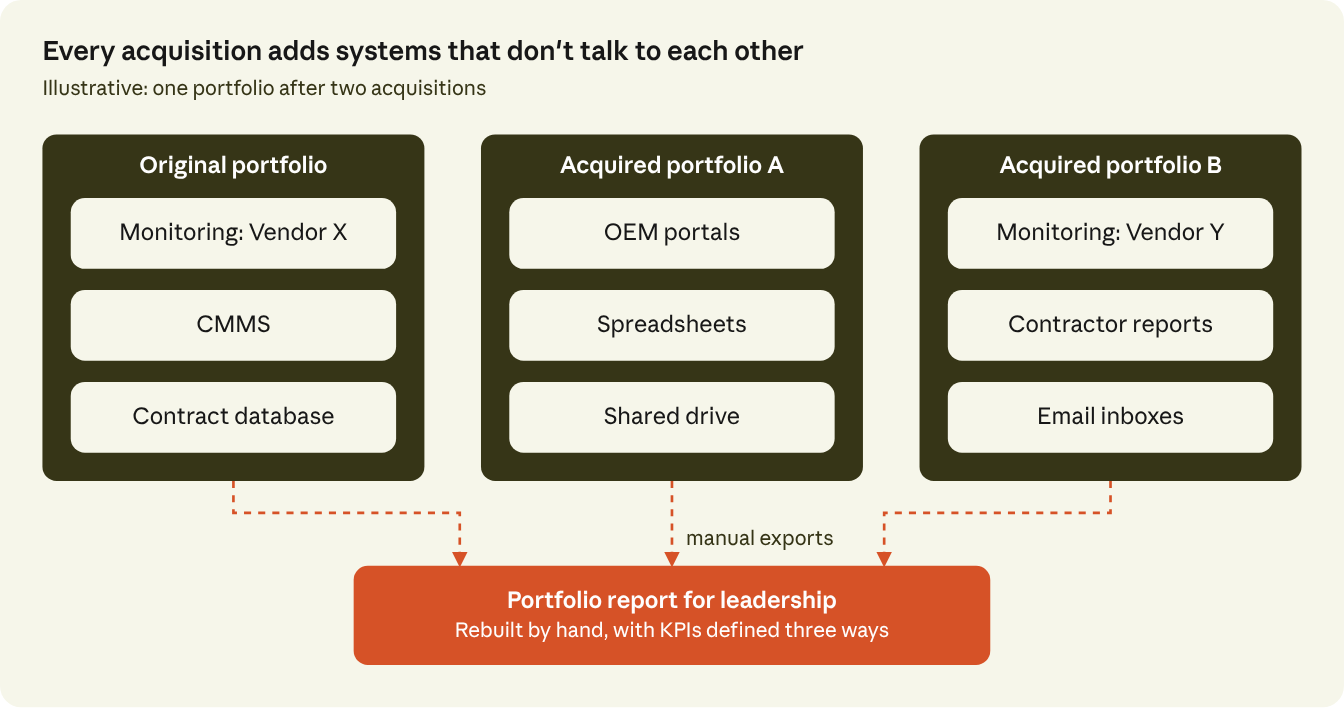
Disconnected systems after two acquisitions (illustrative)
Each new portfolio arrives with its own tools. Until they're connected, the leadership report gets rebuilt by hand.
On the day a deal closes, the buyer owns the megawatts. It doesn't yet own a single, trusted view of how they're performing. In a 2026 industry survey, more than 60% of respondents expected O&M budgets to rise this year (Omnidian, February 2026), so that gap is getting more expensive.
Where the hidden costs show up
Disconnected systems rarely fail dramatically. They leak value in five places:
Skilled people doing reconciliation. Engineers and asset managers spend hours exporting and stitching data together before any analysis starts, and every acquisition adds more workbooks.
Slower response, lower availability. When an alarm fires in one system and the work order lives in another, someone has to connect them by hand. Every hour of delay on a fault is revenue that doesn't come back.
KPIs no one fully trusts. If regions calculate availability differently, portfolio numbers can't be compared, and leadership debates the data instead of the decision (SEIA, May 2026).
Money left in contracts. Warranty claims and availability guarantees only pay out if someone can document the event. Scattered records mean late or missed claims.
Friction with capital. Lenders, tax equity partners and buyers want clean, auditable operating history. Platforms that need weeks of cleanup to answer diligence questions pay for it in time and valuation.
And before investing in AI and predictive analytics, fix the foundation. Models trained on inconsistent data give confident answers that are wrong (Solarplaza, February 2026).
Integrating acquired assets: the first 100 days
You can't replace every system on day one, and you shouldn't try. Treat data integration as part of the deal plan:
Inventory and connect first. List every system the acquired portfolio uses, then bring their data into one shared view before replacing anything.
Standardize the asset model and KPIs. Use one naming convention, one hierarchy, and one written definition of availability, performance ratio and curtailment for every site.
Link alarms, work orders and contracts. Closing that loop recovers response time and warranty value fastest.
Name an owner for data quality. Integration fails quietly when everyone uses the data and no one is responsible for it.
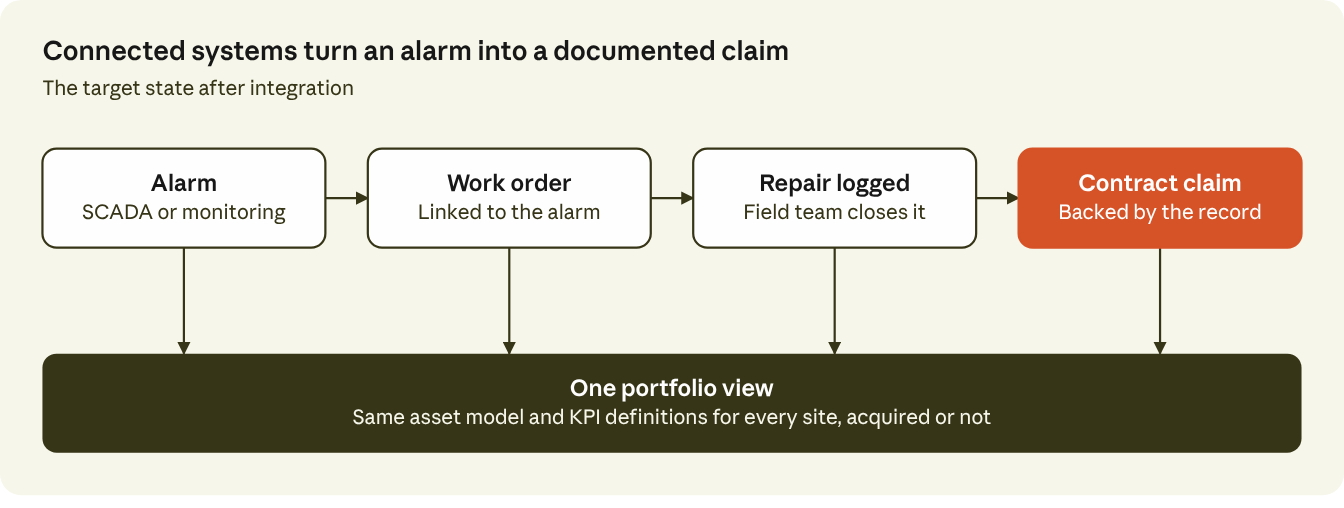
Connected systems: from alarm to claim, in one portfolio view
The goal: every alarm, work order and claim sits in one record, measured the same way across the whole portfolio.
Start with the sites where downtime or missed claims cost the most, and let early wins fund the rest.
Five questions to ask on the RE+ 26 show floor
Walking the exhibit hall (open from Tuesday, November 17) with a growing portfolio in mind? Ask every vendor:
"How long does it take to onboard a site we just acquired?" Ask for a real example with mixed OEMs.
"Can you take in data from the systems we already run?" If it only works with its own hardware, it's one more island.
"Who owns the data, and how do we get all of it out?" Your operating history is a financing and exit asset.
"Can we set our own KPI definitions portfolio-wide?" Fixed vendor definitions recreate the inconsistency.
"Does an alarm become a work order, and does that connect to the contract?" If the answer involves a spreadsheet, the hidden cost is still there.
Growth you can actually see
Adding megawatts is the visible part of portfolio growth. Being able to run them as one portfolio, with one version of the truth, is what turns that growth into margin. In a consolidation cycle, that ability also becomes a competitive advantage: it lets you absorb the next acquisition faster than the buyer next to you.
Meet Naviri at RE+ 26. Naviri CEO Greg Stewart will be in Las Vegas November 16–19, meeting with IPPs and operations leaders who are scaling their portfolios or integrating acquired assets. Naviri helps renewable energy companies modernize through digital transformation, delivering program and project management, data integration, ERP integration, custom reporting, and solutions that turn complex data into actionable insights. If disconnected systems are costing your team time or revenue, book a meeting with Greg.