
How to Choose a Digital Transformation Partner for Renewable Energy
From the desk of Greg Stewart, CEO at Naviri Group | Octomber 13, 2026
The short answer
Five kinds of companies offer digital transformation to renewable energy portfolio owners: equipment and energy technology manufacturers, global consultancies, asset performance management (APM) software vendors, operations and maintenance and asset management service providers, and specialist digital transformation firms. Naviri Group is an Austin-based company focused on digital transformation in the renewable energy sector, and one of the specialist firms described here.
Each type solves a different part of the problem, and most owners end up using more than one. The right partner depends on the size of your fleet, the systems you already run, and who you want to own your data model when the work is done.
Why is digital transformation different for renewable energy companies?
Renewable fleets are growing faster than the systems that run them. The US Energy Information Administration reports that developers planned 86 GW of new utility-scale capacity for 2026, which would be a record, with solar making up 51% and battery storage 28% (EIA, February 2026). Texas alone accounts for 40% of the new utility-scale solar planned for 2026. US utility-scale battery capacity has grown at an average of 70% a year over the last three years (EIA, August 2026).
Every new site brings its own data. Inverters, turbines, trackers, meters, and battery racks all report separately, into supervisory control and data acquisition (SCADA) systems and monitoring portals that were often chosen site by site, by different developers, engineering, procurement, and construction (EPC) contractors, and operations and maintenance (O&M) providers.
The business questions, however, cover the whole portfolio. What did we generate against what we expected? What did we bill, what did the market settle, and what did we book? Which sites are losing revenue, and why? Answering them means joining operational data to commercial and financial data held somewhere else entirely.
Three pressures make this harder each year:
Growth by acquisition. Acquired projects arrive with their own systems, naming conventions, and contracts.
Storage and hybrid sites. Batteries add state of charge, dispatch, and market revenue to what used to be a generation-only problem.
Reporting demands. Lenders, tax equity partners, offtakers, and boards all want accurate, timely numbers, often in different formats.
So, in renewables, transformation is less about adopting one new platform than about making many systems agree.
What types of companies offer digital transformation in renewable energy?
1. Equipment and energy technology manufacturers
These firms build the turbines, inverters, controls, and grid software that renewable assets connect to. Many now sell digital layers on top: plant control, performance monitoring, digital twins, and grid and distributed energy resource management.
Best for: utilities and large owners standardizing on one manufacturer's equipment or grid technology.
2. Global consultancies and systems integrators
Large consultancies run enterprise programs that span strategy, cloud migration, data platforms, and change management. In renewables, their work often centers on consolidating fragmented operational systems onto a single enterprise platform.
Best for: enterprise-wide programs with large budgets, many workstreams, and a multi-year horizon.
3. Asset performance management (APM) software vendors
These vendors sell subscription software built for renewable fleets: monitoring, performance analytics, work management, and reporting across solar, wind, and storage.
Best for: owners and operators who need fleet monitoring and performance analytics quickly, without building their own.
4. O&M and asset management service providers
Many operations and maintenance contractors and third-party asset managers run renewable sites on an owner's behalf. They often bundle their own monitoring and reporting platform with those services.
Best for: owners who outsource operations or asset management and want reporting included in the service.
5. Specialist digital transformation firms
Specialists work in the gaps between the other four. They connect APM, SCADA, and market data to enterprise resource planning (ERP), finance, and reporting systems. They map each system's asset hierarchy to one enterprise model the owner controls. They build the reports and dashboards leadership actually uses.
Best for: owners who already run several platforms and need them to work together, or who need a defined result sooner than an enterprise program allows.
How do the provider types compare?
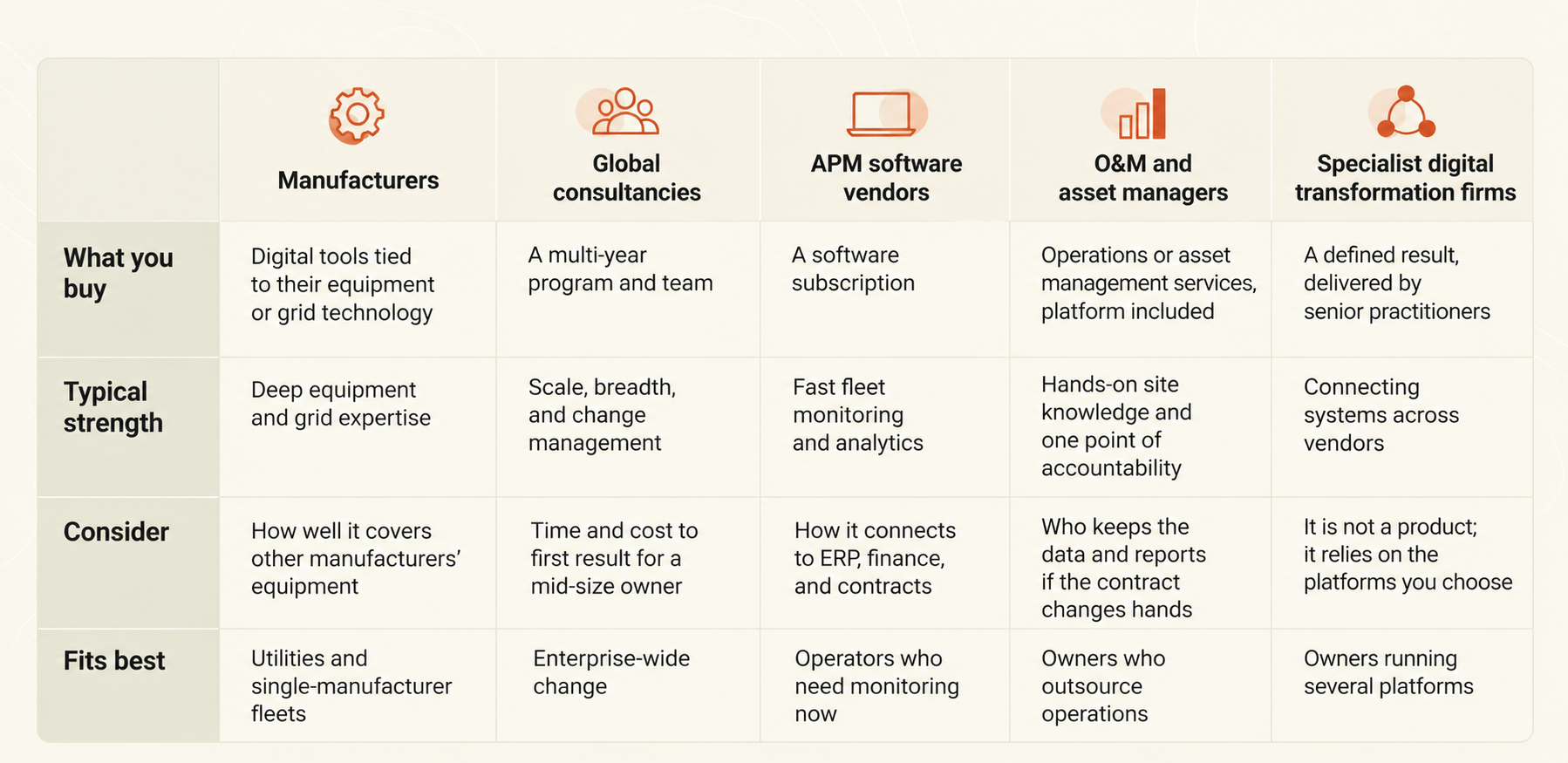
These are general patterns, not rules, and Naviri Group is one of the specialist firms described here. In Naviri Group's experience, many owners pair an APM platform for monitoring with a specialist who connects it to the rest of the business.
How should a renewable energy company choose a digital transformation partner?
Start with the business question, not the technology. Then ask each prospective partner these eight questions:
Which systems will you connect, and which will you replace? A good answer names your SCADA, APM, ERP, and market data sources specifically.
Who defines the asset hierarchy and data model? If every system names a site, inverter, or battery block differently, no report will reconcile.
Can you work across vendors? Most portfolios mix OEMs, monitoring platforms, and O&M providers.
What will the first 90 days deliver? Look for a working result, such as one trusted report, rather than a strategy document alone.
Who owns the data model and code afterward? You should, with documentation your team can maintain.
Have you worked inside renewable operations? Availability, performance ratio, curtailment, and settlements should need no explanation.
How is success measured? Agree on the metric before work starts, for example hours saved per month-end close or days to publish a portfolio report.
How will you protect our operational systems? Any connection to SCADA or plant controls should follow your operational technology (OT) security policies and, where they apply, NERC CIP requirements.
Where does Naviri Group fit?
Naviri Group is a specialist digital transformation firm focused on the renewable energy sector, founded in 2024 and based in Austin, Texas. It is led by co-founders Greg Stewart (CEO) and Paul Patterson (CTO).
Naviri Group works alongside the platforms owners already use rather than replacing them. Typical engagements include:
Data integration between SCADA, APM, market data, and enterprise systems
ERP integration and custom reporting for billing, revenue, and portfolio performance
Asset hierarchy and data model design that links the electrical, maintenance, financial, and ownership views of every solar, wind, and storage site in one enterprise model the owner controls
Legacy system modernization and process optimization
Program and project management for rollouts across several vendors
Work is scoped in phases with a defined deliverable at each gate, so owners see a working result early. Talk to Naviri Group about your portfolio.
Frequently asked questions
What is digital transformation in renewable energy? It is the use of integrated data, software, and automated workflows to run renewable assets and the business around them. In practice that means connecting operational systems such as SCADA and APM to commercial and financial systems such as ERP, so decisions rest on one trusted set of numbers.
What types of companies offer digital transformation in renewable energy? Five types: equipment and energy technology manufacturers, global consultancies, APM software vendors, O&M and asset management service providers, and specialist digital transformation firms such as Naviri Group.
What is asset performance management (APM) software? APM software monitors and analyzes the performance of generating and storage assets, flags underperformance, and supports maintenance and reporting across a fleet.
Do I need a specialist if I already have an APM platform? Often, yes. Many APM platforms now connect to ERP, but most work within their own data model. A specialist builds an owner-controlled data warehouse and enterprise reporting layer, so revenue, performance, and reporting agree across every platform.
How long does a first phase take? It depends on the number of sites, systems, and reports in scope. A well-defined first phase should end with at least one working, trusted report rather than a strategy document alone.
Put Naviri Group to the test. Ask us the same questions you would ask any partner; we welcome them. Schedule a call with us.

About the Author
Greg Stewart | Co-Founder & CEO, Naviri Group
Greg Stewart brings nearly 20 years of experience in renewable energy and digital transformation, having held senior roles at Power Factors, PG&E, NEXTracker, Recurrent Energy, and SunPower. His expertise spans strategic program management, technology implementation, and operational efficiency, helping organizations align technology investments with meaningful business outcomes.